



The decision that separates scaling apparel brands from stagnating ones often comes down to manufacturing infrastructure. Brands in the $1M–$5M revenue range typically piece together production from multiple suppliers, accept inconsistent quality across runs, and operate with minimal production visibility. Brands that break through that ceiling almost universally share one thing: a reliable, deep private label manufacturing partnership.
This post is for brands that have found product-market fit and are now asking a harder question: how do we manufacture at the quality and volume our next phase demands — without rebuilding from scratch every season?
The Difference Between a Supplier and a Manufacturing Partner
A supplier takes your order and fills it. A manufacturing partner engages at the design stage, flags sourcing issues before they become production problems, and proactively offers alternatives when materials, capacity, or timelines shift.
For established brands, this distinction matters enormously. When producing 3,000+ pieces per colorway across multiple seasonal collections, the cost of a late discovery — wrong fabric weight, off-spec dyeing, labeling error — scales with your volume. Manufacturing partners who build quality checkpoints into their workflow catch problems when they’re cheap to fix, not when they’ve already been cut and sewn.
What Full Private Label Production Actually Includes
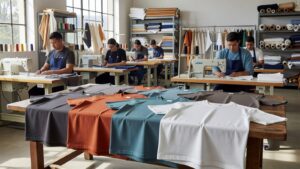
Many manufacturers describe themselves as ‘full service’ but outsource critical steps. When evaluating a private label partner, probe specifically for in-house capability at every stage:
• Fabric sourcing and knitting. Custom fabric to your specification, not commodity stock.
• Pattern development and grading. Technical designers on staff — no completed tech pack required upfront.
• Sampling and fit review. Fast-turnaround production samples with digital revision cycles.
• Cut and sew. In-house cutting and assembly — not subcontracted.
• Custom decoration. Screen printing, embroidery, sublimation, heat transfer — all internal.
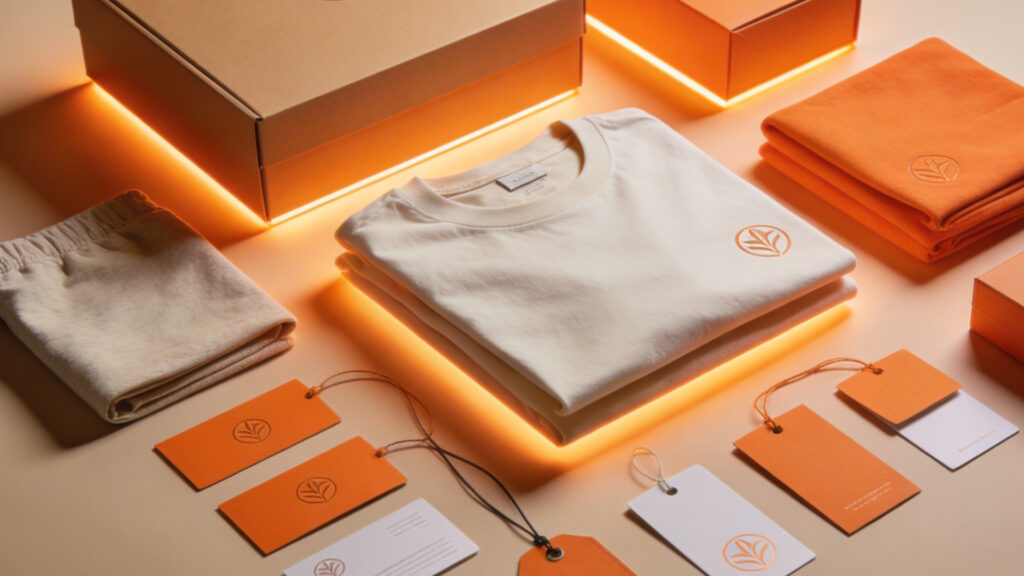
• Labeling and packaging. Custom woven labels, hangtags, poly bags, and retail-ready packaging applied in-line.
• Global shipping. Freight consolidation and customs documentation handled end-to-end.
Managing Multi-Collection Production Calendars
Established brands running two to four seasonal collections annually need a manufacturer who can hold capacity commitments across the year. Production calendars should be planned 4–6 months in advance, with fabric procurement triggered at the point of design approval, not at the point of order submission.
The best manufacturing partners offer dedicated capacity blocks for anchor clients — allowing brands to plan collections with confidence rather than competing for peak-period production slots. If your manufacturer can’t tell you today what their Q3 capacity looks like, that’s a signal worth taking seriously.
Protecting Brand Integrity Across Runs
Color consistency across production runs is one of the most underappreciated challenges. The navy that defined your SS24 collection must match your AW24 reorder — produced six months later, from a different fabric batch, potentially with a different dye lot.
Manufacturers with rigorous color management — Pantone-matched specifications, documented dye formulas, and pre-production lab dips for each new run — protect brand equity in ways that are invisible until they go wrong.
The Economics of Going Deeper With One Manufacturer
Spreading production across three manufacturers to ‘reduce risk’ often creates more risk. Each manufacturer has a learning curve with your brand’s quality standards, communication preferences, and technical requirements. Consolidating volume with one deeply capable partner typically yields better per-unit economics (volume pricing), better quality consistency, and better speed to market.
| Zega Apparel supports established brands with full private label production From custom fabric sourcing through retail-ready packaging — across a 50,000 sq ft vertically integrated facility. Serving 3,000+ brands in 30+ countries. |
| About Zega Apparel |
| Zega Apparel is a vertically integrated custom clothing manufacturer serving 3,000+ brands across 30+ countries from a 50,000 sq ft production facility. From concept and sampling to bulk cut-and-sew, decoration, private label packaging, and global shipping — everything happens under one roof, giving established brands the control and consistency they need at scale.Recognized as a trusted manufacturing partner for mid-to-large enterprises, Zega Apparel delivers consistent quality, transparent communication, and reliable timelines on every order. |
FREQUENTLY ASKED QUESTIONS
| What is private label apparel manufacturing and how does it work? |
| Private label apparel manufacturing means a brand designs its own clothing line — with custom fabrics, labels, and branding — produced by a third-party manufacturer under the brand’s name. At Zega Apparel, the process covers everything from initial design consultation and tech pack creation through sampling, bulk production, custom labeling, and packaged delivery — allowing brands to go to market under their own identity without owning a factory. |
| How much does private label apparel manufacturing cost for established brands? |
| Private label manufacturing costs depend on fabric selection, garment complexity, decoration method, order volume, and packaging requirements. Established brands ordering at scale (1,000+ pieces per style) benefit from tiered quantity pricing that significantly reduces per-unit cost. Zega Apparel provides transparent cost breakdowns with no hidden charges — including setup, sampling, labeling, and freight. |
| Can Zega Apparel manufacture custom fabrics for private label brands? |
| Yes. Zega Apparel offers custom fabric knitting for clothing brands with a minimum order quantity of 200 pieces. Brands can specify fiber composition, weight, weave structure, and colorway for custom fabric development — ensuring their collection has a proprietary material base that cannot be replicated by competitors sourcing off-the-shelf fabrics. |
| How does Zega Apparel ensure color consistency across multiple production runs? |
| Zega Apparel uses Pantone-matched color specifications, documented dye formulas retained from initial production runs, and pre-production lab dips for every new run. This process ensures that colorways remain consistent across seasons, even when produced from different fabric batches — protecting brand identity and customer expectations for established labels. |
| Does Zega Apparel offer custom labels and packaging for private label orders? |
| Yes. Zega Apparel provides a full range of custom branding options including woven labels, heat-pasted labels, steel embossed labels, satin labels, cotton fabric labels, hangtags, and custom packaging — all applied in-line during production. Brands receive fully retail-ready garments requiring no additional processing before sale or distribution. |
ABOUT THE AUTHOR
| Tom Brady is the weekly publisher of fashion blogs and articles at Zega Apparel. He is devoted to providing readers with fast-paced, well-researched stories — whether a deep-dive blog or an industry analysis piece. What began as an undergraduate hobby of writing about the fashion industry has grown into a top blog and full-time role. His interests are simple: anything that informs, educates, and engages readers about the apparel manufacturing industry and the brands that shape it. |

