



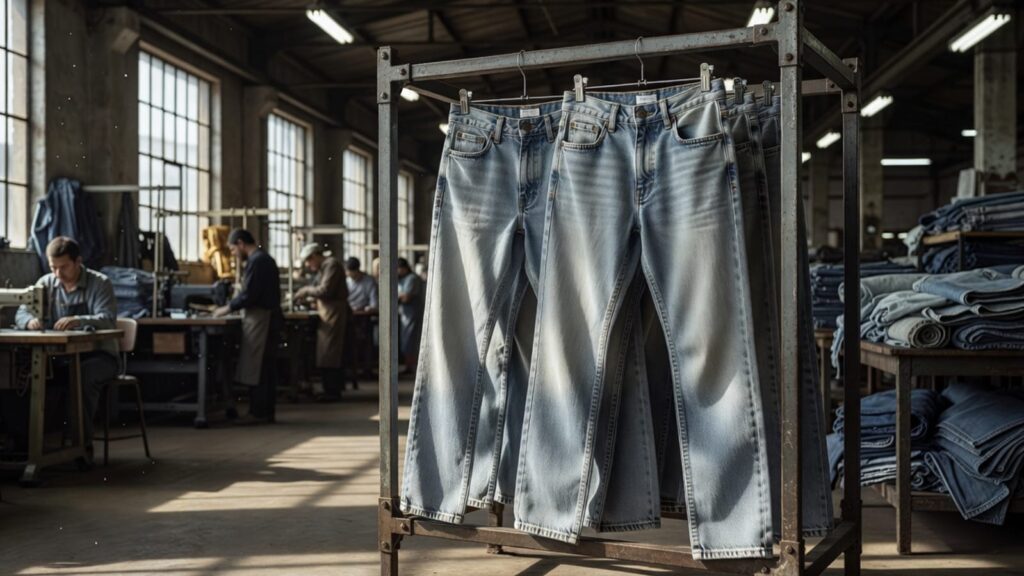
Custom denim is one of the most technically demanding product categories in apparel manufacturing — and one of the most commercially rewarding for brands that get it right. A well-made pair of custom jeans carries margins that few other garments can match, builds genuine brand loyalty, and scales beautifully once production is dialled in.
But finding a reliable jeans manufacturer is harder than sourcing most other garments. Denim production requires specialist knowledge of fabric construction, wash treatments, hardware, and fit architecture that not every clothing manufacturer possesses. This guide walks you through everything a clothing brand needs to know about sourcing custom jeans — from choosing the right denim manufacturer to understanding the production process from start to finish.
What Makes Denim Manufacturing Different from Other Apparel?
Denim is a woven fabric — typically a 3×1 twill weave of cotton yarn dyed with indigo — and its production involves processes that are entirely unique to the category. Wash treatments, stretch content, hardware selection, and the finish achieved after washing can each make or break a denim product. Most clothing manufacturers can sew a t-shirt. Comparatively fewer can produce custom jeans to a standard that competes at retail.
The Key Variables in Denim Manufacturing
When working with a jeans manufacturer, the following decisions define your final product:
· Fabric weight and weave — denim is typically sold in ounce weights (oz) rather than GSM. Lightweight denim runs 8–10 oz, mid-weight 11–12 oz, and heavyweight 13–14 oz and above. Heavier denims are more durable and structured; lighter weights are more comfortable in warm climates and lend themselves to a refined silhouette.
· Stretch content — rigid (0% stretch) denim produces the most traditional look and feel. 1–2% elastane creates a comfort stretch. 2–4% elastane gives a significant stretch suitable for slim and skinny fits. Some brands are now using 4-way stretch fabrics for performance-oriented denim.
· Indigo vs. sulphur dye — classic blue jeans use indigo dye, which is known for its characteristic fade patterns. Sulphur dyeing is used for black and coloured jeans. The dye type affects how the fabric responds to wash treatments and how it ages over time.
· Wash treatments — stone wash, enzyme wash, acid wash, sand blast, and hand distressing are applied after sewing to create the desired aesthetic. Each treatment adds cost and lead time, and must be approved on a sample before bulk production.
· Hardware — rivets, buttons, and zip pulls are selected for both durability and brand identity. Custom branded hardware is available at MOQs of 500–1,000 pieces per style and can significantly elevate the perceived value of your product.
How to Evaluate a Jeans Manufacturer Before Placing an Order
The stakes in denim are higher than most apparel categories — the fabric is more expensive, the production is more complex, and errors in fit or wash are harder to hide. Here is how experienced buyers evaluate jeans manufacturers:
Sample Quality Is Everything
Request a pre-production sample before committing to any bulk order. Evaluate the sample against your tech pack with precise attention to: seam construction and stitching density (denim seams receive significantly more stress than most garments), the accuracy of measurements across all sizes, the quality and placement of hardware, the accuracy of the wash treatment versus your approved reference, and the hand feel and weight of the fabric.
A manufacturer who resists sampling, charges disproportionately for samples, or produces samples that consistently miss spec is not a manufacturer to trust with a bulk denim order.
Technical Expertise in Denim Construction
Ask the manufacturer directly about their denim experience: what wash facilities do they have in-house or access to? Can they produce your specific wash treatment consistently across a bulk run? Do they have experience with the specific silhouette you are producing — high-rise, relaxed, slim, cargo, or cropped? A strong jeans manufacturer will answer these questions with specific process details, not marketing language.
MOQ and Pricing Transparency
For custom cut and sew jeans production, expect MOQs of 200–300 pieces per style per wash. Lower MOQs are sometimes available for simple styles without wash treatment. Understand the pricing structure: most manufacturers quote a FOB price that includes fabric, cutting, sewing, and basic trimming, with wash treatments priced separately per treatment type. Hardware, custom labels, and packaging are typically quoted as add-ons.
The Custom Jeans Production Timeline
Denim takes longer than most garments to produce. Plan for the following timeline when placing a custom jeans order:
· Fabric sourcing and approval: 1–2 weeks for the manufacturer to source denim to your spec and share swatches or lab dips for approval
· Pattern development: 1 week for a new silhouette or 3–5 days for an adaptation of an existing block
· First sample: 14–18 business days from tech pack approval
· Sample revision rounds: 7–10 business days per round — denim typically requires 2–3 rounds to nail fit, wash, and hardware
· Bulk production: 5–7 weeks for orders of 200–600 pieces; 7–10 weeks for 1,000+ pieces depending on wash complexity
· Total from tech pack to delivery: 10–16 weeks for a new style. Plan accordingly when building your production calendar.
Denim Silhouettes: What a Jeans Manufacturer Can Produce for Your Brand
A full-service custom jeans manufacturer can produce any silhouette your brand requires. The most commercially active categories in 2026 are:
· Slim fit — the perennial bestseller across men’s and women’s ranges. A well-engineered slim fit with 1–2% stretch is accessible to the widest customer base and the safest first production run for a new brand.
· Relaxed and wide-leg — the dominant trend in premium denim and streetwear for the last three years. Requires careful proportioning in the rise and thigh to avoid looking shapeless.
· High-rise straight — strong in the women’s market. Requires precise rise measurement and a clean back pocket placement to read as premium.
· Baggy and carpenter — increasingly mainstream across unisex denim. Utility detailing (cargo pockets, hammer loops, D-rings) can be added to standard jeans construction at moderate additional cost.
· Cropped and flare — most commonly in the women’s market. Flare construction requires specialist pattern work at the leg opening and a structured hem treatment.
Why Clothing Brands Choose Zega Apparel as Their Jeans Manufacturer
Zega Apparel manufactures custom jeans for clothing brands placing orders from 200 pieces per style. Their denim production capability covers all major silhouettes — slim, relaxed, high-rise, wide-leg, cropped, and cargo — for both men’s and women’s ranges.
Zega’s factory handles fabric sourcing, cutting, sewing, wash treatments, hardware fitting, and private label packaging under one roof. Brands work from their own tech packs or use Zega’s design team to develop spec documents from reference garments. Sampling lead times are 14–18 business days for new styles, with bulk production running 5–7 weeks for standard orders.
| Ready to source custom jeans for your brand? Request a Free quote |
Frequently Asked Questions
Q: What is the minimum order quantity for a custom jeans manufacturer?
Most custom jeans manufacturers require a minimum of 200–300 pieces per style per wash treatment. Simpler styles without specialised wash can sometimes be produced at 200 pieces. Complex silhouettes with multiple wash treatments typically require higher MOQs due to the cost of wash setup and the logistics of batch processing. Zega Apparel works from 200 pieces per colour and style.
Q: How long does it take to manufacture custom jeans?
From tech pack submission to delivery, custom jeans production takes 10–16 weeks. This includes 2–3 weeks for sampling, up to 3 sample revision rounds, 5–7 weeks for bulk production depending on wash complexity, and 1–2 weeks for shipping. Denim is slower to produce than most garments due to wash treatment lead times.
Q: What denim fabric weight should I use for my brand?
The right denim weight depends on your product and market. 8–10 oz is lightweight, comfortable in warm climates, and suits slim contemporary silhouettes. 11–12 oz is the mid-weight standard for most market-level jeans. 13–14 oz produces a premium heavyweight denim popular in heritage and premium streetwear. Most brands starting out work in the 10–12 oz range.
Q: Can a jeans manufacturer add custom branded hardware — buttons and rivets?
Yes. Custom branded hardware — engraved buttons, logo rivets, and branded zip pulls — is standard in custom denim manufacturing. Most manufacturers require a minimum of 500–1,000 pieces for custom hardware production. For brands below that threshold, many manufacturers offer hardware from their in-house library or can source close alternatives.
Q: What is the difference between rigid denim and stretch denim?
Rigid denim contains no elastane — it is 100% cotton with no stretch. It produces the most authentic fade and wear patterns but fits more structurally. Stretch denim contains 1–4% elastane, offering varying degrees of give. 1–2% elastane is a comfort stretch; 2–4% is a performance stretch suitable for slim and athletic silhouettes. Most commercial denim brands work in the 1–2% range.
Q: What wash treatments can a jeans manufacturer apply?
Standard wash treatments include stone wash (softens fabric and fades colour naturally), enzyme wash (biological softening for a cleaner fade), acid wash (creates dramatic high-contrast fading), sand blast (targeted abrasion for worn areas), hand distressing (manual ripping and abrading for a custom vintage look), and tinting (for overdyed or coloured denim effects). Each treatment is priced and sampled separately.

