
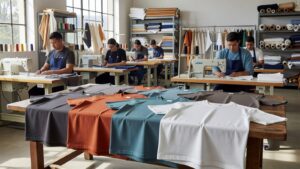






The activewear market is one of the most competitive product categories in apparel — and leggings sit at the centre of it. Every week, new brands enter with similar products, similar price points, and similar claims about quality. The brands that build lasting businesses in this space are the ones who invest seriously in the manufacturing side: the right fabric, the right construction, and a production partner who can maintain quality as they scale.
This guide is written for activewear brand founders and clothing buyers sourcing custom leggings at MOQs of 200 pieces and above. We cover every decision that matters in leggings manufacturing — fabric selection, construction standards, decoration methods, and what separates a serious custom leggings manufacturer from one that will cost you customers.
What to Look for in a Custom Leggings Manufacturer
A capable custom leggings manufacturer does more than cut and sew stretch fabric. The performance requirements of activewear — squat-proof opacity, compression consistency, moisture management, colourfast printing — demand a level of technical precision that separates specialist manufacturers from general apparel factories.
Before shortlisting any leggings manufacturer, evaluate them on the following criteria:
· Stretch fabric expertise — leggings require manufacturers experienced in working with four-way stretch fabrics. Construction techniques that work on woven fabrics fail on stretch — seam allowances, stitch types, and presser foot settings are all different. Ask directly about their experience with the specific fabric you plan to use.
· In-house sublimation or print capability — if your brand uses all-over print or colour-blocked designs, a manufacturer with in-house sublimation printing gives you tighter control over colour matching and print registration across the garment.
· Waistband construction quality — the waistband is the single most important construction element in a legging. It determines comfort during wear, how the garment sits at the waist, and how it holds up over hundreds of washes. Request information on waistband composition (usually a separate waistband fabric with higher spandex content), width, and attachment method.
· Opacity testing — squat-proof fabric is non-negotiable for premium activewear leggings. Ask the manufacturer how they test opacity and at what fabric specifications. Most reputable manufacturers test fabric at 180–240 GSM with 20–25% spandex content for full opacity under stretch.
· Sample accuracy — leggings involve complex grading across sizes. A manufacturer who consistently produces samples that miss measurements at the hip, thigh, or inseam is indicating a pattern-grading problem that will manifest in every size of your bulk production.
The Best Fabrics for Custom Leggings Manufacturing
Fabric selection in leggings manufacturing determines everything: compression level, hand feel, opacity, print compatibility, and longevity. Here is a breakdown of the principal fabric options:
Nylon-Spandex (Polyamide-Elastane)
The premium standard in activewear leggings manufacturing. Nylon-spandex blends — typically 80/20 or 82/18 nylon-to-spandex ratio — produce a silky, high-lustre surface with outstanding durability and colour depth. Nylon is more abrasion-resistant than polyester, which is why it is the first choice for yoga and gym leggings where friction against equipment and flooring is a factor.
The standard weight for performance leggings in nylon-spandex runs 200–240 GSM. Higher GSM provides better opacity and compression; lower GSM produces a lighter, more breathable garment suited to low-impact activities. At 200 GSM and above, a quality nylon-spandex blend is fully squat-proof.
Polyester-Spandex (Polyester-Elastane)
The most common fabric in mid-market activewear leggings. Polyester-spandex blends — typically 88/12 or 90/10 — offer excellent moisture-wicking properties, good stretch recovery, and strong compatibility with sublimation printing. The surface texture is slightly less premium than nylon, but the price point is significantly lower.
Polyester-spandex is the correct choice for all-over printed leggings because polyester accepts sublimation dye at higher colour saturation than nylon. At 200–220 GSM with 12% spandex or above, polyester-spandex is suitable for a full range of performance activities.
Cotton-Spandex
For lifestyle and athleisure leggings positioned closer to the fashion market than the performance market, cotton-spandex at 220–280 GSM is the leading choice. The cotton content gives the fabric a breathable, natural feel that most performance fabrics cannot replicate. The limitation is moisture management — cotton absorbs sweat rather than wicking it, making cotton-spandex less suitable for high-intensity training.
A 95/5 or 92/8 cotton-to-spandex ratio at 240 GSM produces a mid-compression legging with excellent hand feel that works in yoga, pilates, and casual wear — the three largest volume activewear categories.
Recycled Polyester-Spandex (rPET)
The fastest-growing fabric category in activewear manufacturing. Recycled polyester made from post-consumer plastic bottles performs identically to virgin polyester in most performance metrics while reducing the environmental footprint of production. For activewear brands targeting the premium or eco-conscious market, rPET-spandex blends are increasingly a brand requirement rather than an option.
Decoration Methods for Custom Leggings
How you apply your brand’s visual identity to your leggings significantly affects both the aesthetic outcome and the manufacturing complexity. Here are the principal options:
· Sublimation printing — the standard for all-over printed leggings. Dye is transferred directly into the polyester fibres under heat and pressure, producing vibrant, wash-permanent prints with no hand feel. Sublimation requires 100% polyester or high-polyester blend fabrics and cannot be applied to nylon or cotton. The print is applied to the fabric panels before cutting and sewing.
· Screen printing — suitable for logo or graphic placements on solid-colour leggings. Works on both polyester and nylon-spandex fabrics with the correct inks. Screen printing on stretch fabrics requires specialist equipment and techniques to prevent cracking under stretch — not every manufacturer offers this capability.
· Heat transfer / DTF — digital print transferred via heat press. More flexible than screen printing for small-run or complex designs. Slightly less durable over time than sublimation but significantly more flexible in design and colour complexity.
· Colour blocking — different fabric panels in different colours or patterns, cut and sewn together to create the visual design. Popular in premium activewear and technically demanding — seam matching at colour block joins is a key quality indicator.
· Contour seaming and mesh panels — structural and decorative seaming using flatlock or coverstitch techniques. Mesh inserts at the back calf, side panels, or knee areas are both functional (ventilation) and aesthetic. A quality manufacturer produces clean flatlock seams with no puckering.
Why Zega Apparel Is the Custom Leggings Manufacturer for Scaling Activewear Brands
Zega Apparel produces custom leggings for activewear, gym wear, yoga, and lifestyle brands placing orders from 200 pieces per colour and style. Their in-house manufacturing capability covers nylon-spandex, polyester-spandex, cotton-spandex, and rPET fabric options, with in-house sublimation printing, screen printing, and colour-blocking capability.
For brands that are earlier in product development, Zega’s team assists with fabric specification, tech pack development, and waistband design to ensure the first sample reflects a production-ready garment. Sample lead times are typically 10–14 business days for standard styles, with bulk production running 3–5 weeks after sample approval.
| Source your custom leggings line from 200 pieces — Request a Free Quote. |
Frequently Asked Questions
Q: What is the minimum order quantity for a custom leggings manufacturer?
Most custom leggings manufacturers work from a minimum of 200 pieces per colour and style. This applies to cut and sew production in nylon-spandex, polyester-spandex, and cotton-spandex fabrics. For all-over sublimation printed leggings, the MOQ is similar — 200 pieces per print design — because sublimation is applied to fabric panels before sewing, making small runs relatively efficient.
Q: What is the best fabric for custom leggings?
The best fabric depends on your market. For high-performance gym and yoga leggings, 80/20 nylon-spandex at 200–240 GSM is the premium standard — silky, durable, and fully squat-proof. For all-over printed leggings, 88/12 polyester-spandex at 200–220 GSM is the correct choice because polyester accepts sublimation dye at full colour saturation. For lifestyle leggings, 92/8 cotton-spandex at 240 GSM provides the best hand feel.
Q: How do I make sure my leggings are squat-proof?
Squat-proof opacity comes from a combination of fabric weight and spandex content. For nylon-spandex leggings, 200 GSM with 18–20% spandex is the minimum for full opacity under stretch. For polyester-spandex, 200–220 GSM with 12–15% spandex. Request an opacity test at full stretch from your manufacturer before approving any fabric for bulk production.
Q: Can I get all-over printed leggings with custom sublimation designs?
Yes. Sublimation printing allows fully custom all-over designs applied directly to the fabric before the legging is cut and sewn. The design can cover 100% of the garment surface with no colour limitations and no hand feel. Sublimation requires polyester or high-polyester blend fabrics — it cannot be applied to nylon or cotton. Most custom leggings manufacturers offer sublimation from 200 pieces.
Q: How long does it take to manufacture custom leggings?
Custom leggings production typically takes 6–10 weeks from tech pack submission to delivery. This includes 2 weeks for sampling, 1–2 revision rounds, 3–4 weeks for bulk production, and 1 week for shipping. All-over sublimation printed leggings add 1–2 weeks for print panel production before sewing begins. Plan for 8 weeks as a safe baseline for a new style.
Q: What is a flatlock seam and why does it matter for leggings?
A flatlock seam is a stitch type where seam allowances are laid flat on either side of the join rather than folded, producing a seam with minimal bulk and no raised edge on the inside. For leggings, flatlock seams are essential at the inner leg, crotch gusset, and waistband attachment — these are the areas that make direct skin contact and where seam bulk causes discomfort during movement.

