






You have the designs. You have the brand concept. You might even have the customers lined up. What you need now is a custom t-shirt manufacturer who can actually deliver — consistently, at quality, and at a price that keeps your margins intact. The problem is, the apparel manufacturing market is full of suppliers who look great on their website and fall apart when your order hits the floor.
This guide is written for clothing brand founders, private label buyers, and wholesale brands placing orders of 200 pieces and above. We will walk through everything: what to look for in a t-shirt manufacturer, which fabric choices matter, how the production process works, and what separates manufacturers worth building a relationship with from ones worth avoiding.
What Does a Custom T-Shirt Manufacturer Actually Do?
A custom t-shirt manufacturer handles the full production of your t-shirts from raw fabric to finished garment, based entirely on your specifications. This is different from a wholesale blank supplier, who sells you pre-made generic tees you can print onto.
With a true custom manufacturer, you control everything: the fabric composition and weight, the cut and construction, the label and packaging, and any decoration method — screen print, embroidery, DTG, sublimation, puff print, or discharge. Every unit produced matches your approved sample. Nothing is off-the-shelf.
Cut and Sew vs. Blank Decoration — Know the Difference
Most clothing brands eventually face this fork in the road. Blank decoration services take a standard blank t-shirt — usually Gildan or Bella+Canvas — and apply your artwork to it. It is fast and low-cost at small quantities, but the product is identical to every other brand using the same blank.
Cut and sew manufacturing builds your t-shirt from scratch — cutting the fabric from rolls and sewing it to your spec. The result is a garment that is genuinely yours: your fabric weight, your fit, your construction, your brand. At 200+ pieces per style, cut and sew is almost always the stronger commercial choice.
Choosing the Right Fabric for Your T-Shirt Line
Fabric is the single most important decision you will make in t-shirt production. It determines how the garment feels, how it performs over time, how it takes decoration, and how it positions your brand at retail. Here is a practical breakdown of the most common options:
100% Cotton
The default choice for premium basics and streetwear. Ring-spun cotton produces a softer hand feel than open-end spun. Combed cotton removes short fibres for even greater softness and durability. If you are building a premium basics brand, 180–200 GSM combed ring-spun cotton is the industry standard. It takes screen printing exceptionally well and develops a rich texture with wash and wear.
Cotton-Polyester Blends (50/50 or 60/40)
A blend gives you durability, reduced shrinkage, and better shape retention compared to 100% cotton. The trade-off is a slightly more synthetic hand feel. For athletic-adjacent or everyday wear brands, an 80/20 cotton-poly blend at 160–180 GSM hits the sweet spot — it looks like cotton, moves with the body, and holds print well.
Tri-Blend (Cotton / Poly / Rayon)
The softest option available in standard t-shirt production. The rayon content gives the fabric a distinctive drape and a heathered visual texture that has made tri-blend enormously popular in the lifestyle and streetwear market. At 145–160 GSM, it is lighter than most basics brands target, but for the right aesthetic it is unbeatable.
Performance / Moisture-Wicking Polyester
If your brand targets the active or athletic market, 100% polyester performance fabric at 130–160 GSM is the standard. It wicks moisture, dries quickly, and is the only suitable base for sublimation printing. Note: traditional screen printing does not bond well to polyester without specialist inks, so discuss your print method before finalising fabric.
Understanding GSM for T-Shirts
GSM (grams per square metre) is how fabric weight is measured. For t-shirts: 130–160 GSM is lightweight and breathable, suited to warm climates and athletic use. 160–180 GSM is mid-weight, the most common range for everyday branded tees. 180–220 GSM is heavyweight, popular in premium streetwear drops and often used in oversized fits. Most brand founders underestimate GSM — a 10 GSM difference in the same fabric creates a noticeably different product.
What to Look for in a Custom T-Shirt Manufacturer
Not all t-shirt manufacturers are built the same. Here is the checklist experienced buyers use before committing to a production partner:
· Sampling capability — can they produce a proper pre-production sample from your tech pack before bulk production begins? Any manufacturer worth working with insists on sample approval before cutting fabric for a full order.
· MOQ alignment — most quality cut and sew manufacturers work from 200 pieces per colour and design. Be cautious of manufacturers promising 50-piece MOQs on custom cut and sew — the economics rarely work at that scale without cutting corners on fabric or construction.
· In-house decoration — a manufacturer who handles screen printing, embroidery, and labelling under one roof gives you tighter quality control and simpler logistics. When printing is subcontracted, you introduce a quality variable you cannot directly oversee.
· Fabric transparency — your manufacturer should be able to tell you exactly what fabric they are using: fibre content, GSM, and origin. If they cannot answer that question clearly, they are not a manufacturer you want handling your brand.
· Communication speed — response time during sampling is the clearest indicator of how a manufacturer will behave when problems arise in bulk production. A factory that takes a week to respond to a sampling query will take two weeks to resolve a production issue.
· Certifications — for US, EU, and Australian market brands, look for manufacturers with OEKO-TEX Standard 100 certification for fabric safety. For sustainable brand positioning, GRS (Global Recycled Standard) or GOTS (Global Organic Textile Standard) certifications matter.
The Custom T-Shirt Production Process: What to Expect
Understanding the production process lets you plan your inventory timeline and avoid the most common delays. Here is how a typical custom t-shirt order moves through production:
· Tech Pack Submission — you provide a complete tech pack: measurements, fabric spec, construction details, artwork placement, label and trim requirements. A well-prepared tech pack reduces sample revision rounds significantly.
· Fabric Sourcing and Approval — the manufacturer sources fabric matching your spec and shares a fabric swatch or lab dip for your approval before cutting begins.
· First Sample Production — typically takes 10–14 business days. The sample is shipped to you for fit, fabric, and construction review.
· Sample Revision Rounds — most orders require 1–2 revision rounds. Complex fits or detailed construction may require 3. Each round adds 7–10 business days.
· Bulk Production — once the sample is approved and the purchase order confirmed, bulk production begins. For t-shirts at 200–500 pieces, bulk production typically takes 3–4 weeks. Larger orders of 1,000+ pieces may run 5–6 weeks depending on factory capacity.
· Quality Control and Packing — a pre-shipment inspection confirms that bulk production matches the approved sample. Units are packed and labelled according to your specifications.
Private Label T-Shirt Manufacturing: Adding Your Brand Identity
Private label t-shirt manufacturing means producing garments under your own brand label — your woven neck labels, hang tags, custom packaging, and any branding details that make the product unambiguously yours. This is standard practice for established clothing brands and increasingly common even at the 200-piece level.
The key elements of a complete private label t-shirt order include: woven or printed neck labels (replacing manufacturer labels entirely), custom hem labels, hang tags in your brand’s design, polybag or box packaging with your branding, and branded size stickers or tissue paper for premium unboxing.
If you are scaling beyond your first production run, building a private label pack — a complete set of branded trims and labels sent to your manufacturer for every order — creates consistency across your product line regardless of the order quantity.
Why Clothing Brands Source T-Shirts from Zega Apparel
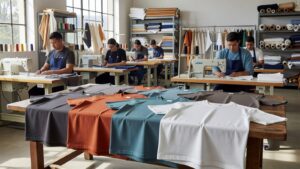
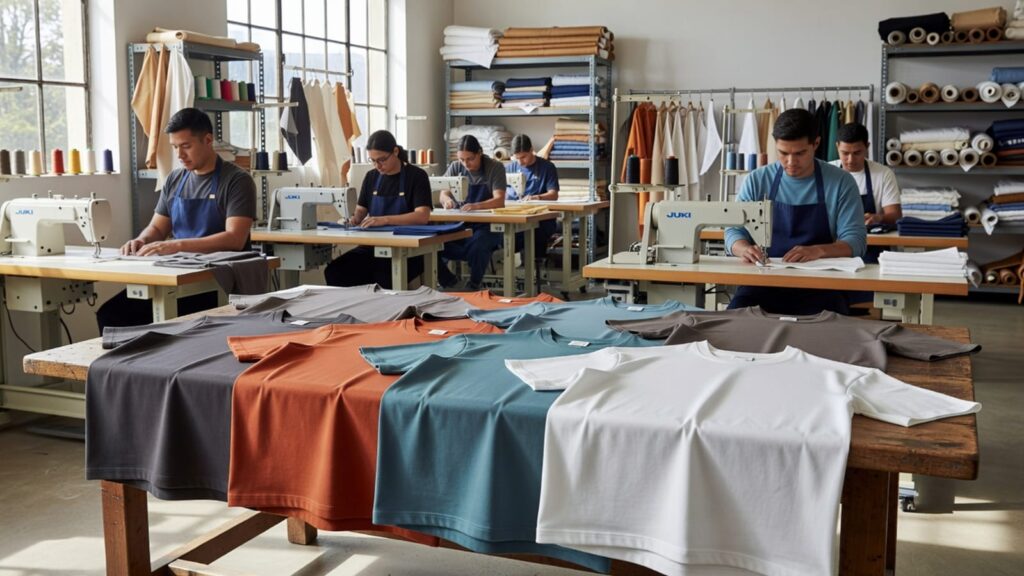
Zega Apparel is a custom clothing manufacturer with over 3,000 brands served across the USA, UK, Canada, and Australia. Their t-shirt manufacturing service operates from a vertically integrated factory — fabric sourcing, cutting, sewing, screen printing, embroidery, DTG, and private label packaging all happen under one roof.
For brands placing orders of 200 pieces and above, Zega provides cut and sew t-shirt production across all fabric types and weights, with full private label capability. Their team works directly from client tech packs or assists with spec development for founders who are earlier in the design process. Sample lead times are typically 10–14 business days, and production timelines for standard orders run 3–5 weeks after sample approval.
Frequently Asked Questions
Q: What is the minimum order quantity for a custom t-shirt manufacturer?
Most reputable cut and sew t-shirt manufacturers require a minimum order of 200 pieces per colour and design. This MOQ reflects the economics of fabric sourcing, pattern cutting, and production setup. Some manufacturers offer lower MOQs on blanks with print decoration, but for fully custom cut and sew t-shirts, 200 pieces is the standard starting point for quality production.
Q: How long does custom t-shirt manufacturing take?
From tech pack submission to delivery, custom t-shirt production typically takes 5–8 weeks. This includes 2 weeks for sampling, 1–2 weeks for sample review and revision, 3–4 weeks for bulk production, and 1 week for shipping. Simpler styles with clean specs can be completed in 5 weeks. Complex construction or large orders may take 8–10 weeks.
Q: What is the best fabric for a custom t-shirt brand?
The best fabric depends on your brand positioning. For premium basics and streetwear, 180–200 GSM combed ring-spun 100% cotton is the industry standard. For athletic and everyday wear, an 80/20 cotton-poly blend at 160–180 GSM offers durability with reduced shrinkage. For the softest hand feel, a tri-blend of cotton, polyester, and rayon at 145–160 GSM is excellent.
Q: What does a custom t-shirt manufacturer need from me to start production?
A custom t-shirt manufacturer needs a complete tech pack: your garment measurements, fabric specification including fibre content and GSM, construction details, decoration placement with artwork files, and label and trim requirements. Some manufacturers can assist with tech pack development if you are working from reference garments or sketches rather than a formal specification document.
Q: What is the difference between a custom t-shirt manufacturer and a screen printer?
A custom t-shirt manufacturer builds the garment from scratch using your fabric and construction specifications — they create the blank itself before any decoration is applied. A screen printer applies your artwork to a pre-made blank t-shirt that was produced by someone else. For brands that want full control over their product’s fabric, fit, and construction, a custom manufacturer is the right choice.
Q: Can I get private label t-shirts with my own neck label and packaging?
Yes. Most custom t-shirt manufacturers offer full private label services — woven or printed neck labels replacing the manufacturer’s label, custom hang tags, polybag packaging with your branding, and size labelling. Private label capability is standard at MOQs of 200 pieces and above.

